



Improving your EcoVadis rating: The 10 most important measures for companies
More and more companies are facing the challenge of improving their EcoVadis rating. Customers, business partners, and supply chains are increasingly demanding structured proof of sustainability. A good EcoVadis score is therefore becoming more and more often a prerequisite for winning new orders or remaining part of international supply chains.
Many companies are therefore asking themselves:
- How can you improve your EcoVadis rating?
- Which measures actually affect the valuation?
- What role do CO₂ footprints, sustainability reports, and ESG data play?
In this article, we highlight the 10 most important measures companies can take to improve their EcoVadis rating, from CO₂ and sustainability strategy to structured data collection . Download our free guide to improving your EcoVadis rating here now.
What is EcoVadis and why is the rating important?
EcoVadis is a globally used platform for assessing the sustainability performance of companies.
The assessment is based on four key areas:
- Environment
- Labor and human rights
- ethics
- Sustainable procurement
Companies want to improve their EcoVadis rating because a good result offers numerous advantages:
- greater chances in tenders
- better position in supply chains
- stronger reputation in the area of sustainability
- Better preparation for ESG and reporting requirements
How can you improve your EcoVadis rating?
Companies can improve their EcoVadis rating by systematically implementing sustainability measures and, above all, documenting them in a structured manner.
The most important levers are:
- Preparation of a CO₂
- Analysis of Scope 3 emissions
- Definition of a sustainability strategy
- Setting measurable sustainability goals
- Preparation of sustainability reports (e.g., VSME or CSRD)
- Introduction of clear corporate guidelines
- Training and integration of employees
- Documentation of sustainability measures
- Sustainability management in the supply chain
- Centralized collection of ESG and sustainability data
Companies that address these issues in a structured manner create the most important prerequisites for improving their EcoVadis rating.
What factors influence the EcoVadis rating?
To improve their EcoVadis rating, companies must ensure two things above all else:
- Actually implementing sustainability measures
- document these measures in a structured manner
Many companies lose points because they do not have sufficient data or evidence.
The following overview shows key measures:
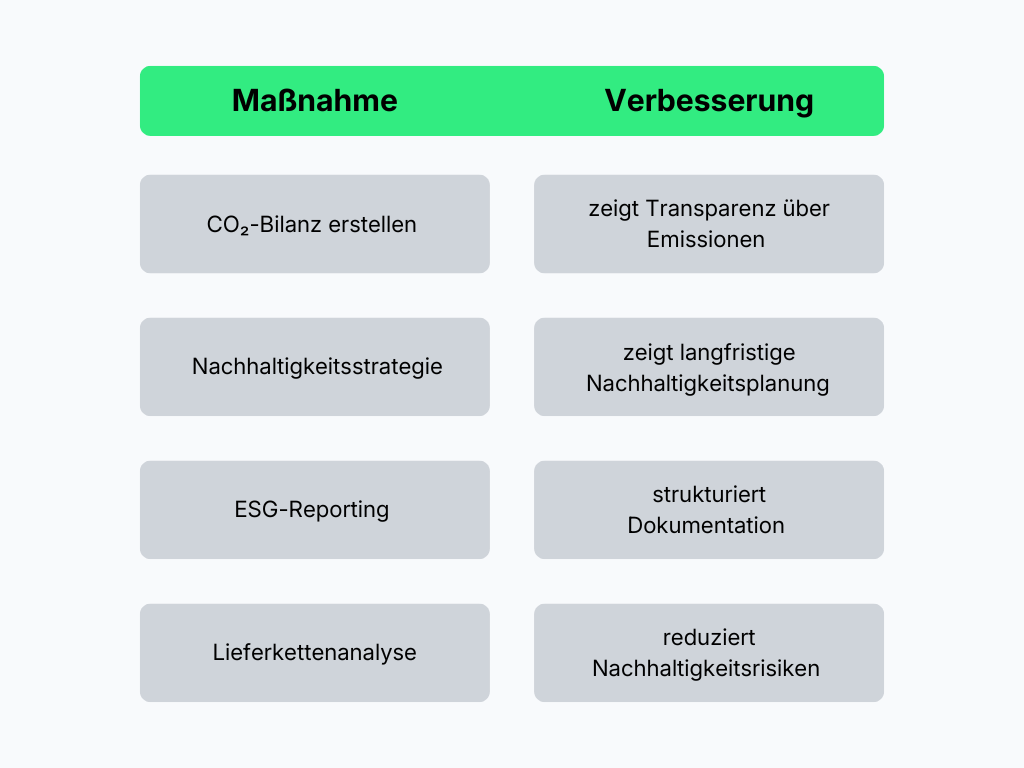
Measure 1: Create a CO₂
One of the most important measures for improving the EcoVadis rating is to draw up a CO₂.
A corporate carbon footprint analysis shows:
- how many emissions a company causes
- where the largest sources of emissions are located
- what reduction measures are possible
Companies should cover at least the following areas:
- Scope 1 emissions
- Scope 2 emissions
- First Scope 3 categories
A CO₂ often forms the basis for many other sustainability measures. In our guide "5 steps to CO₂, " we show you how to create one.
Measure 2: Analyze Scope 3 emissions
Many companies want to improve their EcoVadis rating, but initially only consider direct emissions.
However, a large proportion of emissions are generated in the value chain.
Typical Scope 3 sources are:
- purchased products
- logistics
- business trips
- Use of products
EcoVadis gives a positive rating when companies analyze these emissions and define initial reduction measures.
Measure 3: Define a sustainability strategy
A clear sustainability strategy helps companies improve their EcoVadis rating.
A strategy includes, for example:
- long-term sustainability goals
- clear responsibilities
- regular progress measurement
- Integration into business processes
EcoVadis gives a positive rating if sustainability is firmly established within the company for the long term.
Measure 4: Set sustainability goals
To improve their EcoVadis rating, companies should define measurable goals.
Examples include:
- CO₂ reduction targets
- energy efficiency programs
- Waste reduction
- sustainable procurement
It is important that progress is reviewed regularly.
Measure 5: Prepare sustainability reports
Many companies improve their EcoVadis rating by reporting their sustainability activities in a structured manner.
Typical report formats are:
- ESG reports (e.g., according to GRI)
- VSME reporting
- CSRD reporting
These reports compile important information such as:
- emissions data
- measures
- sustainability goals
- progress
Measure 6: Establish sustainability guidelines
EcoVadis also assesses whether companies have clear guidelines on sustainability and compliance.
Examples include:
- environmental policies
- Code of Conduct
- Human Rights Directive
- anti-corruption policy
- Supplier Code of Conduct
These guidelines demonstrate that sustainability is firmly anchored within the company's organizational structure.
Measure 7: Involve and train employees
Companies can improve their EcoVadis rating if sustainability is actively practiced within the company.
These include:
- Training courses for employees
- internal communication
- clear responsibilities
Strong internal anchoring improves the implementation of sustainability measures.
Measure 8: Document sustainability measures
Many companies are already implementing numerous sustainability measures, but are unable to provide sufficient evidence of this.
Typical examples are:
- energy efficiency programs
- sustainable mobility
- Reduction of packaging
- Use of renewable energies
Structured documentation helps to improve the EcoVadis rating.
Measure 9: Consider sustainability in the supply chain
EcoVadis also assesses sustainable procurement.
Companies should therefore:
- Define sustainability requirements for suppliers
- Analyze risks in the supply chain
- Regularly review suppliers
International supply chains in particular play an important role in the EcoVadis rating.
Measure 10: Centralized collection of sustainability data
One of the most effective measures for improving the EcoVadis rating is the central collection of sustainability data.
In many companies, relevant information is distributed across:
- Excel files
- individual departments
- document management systems
- emails
Structured data collection facilitates:
- CO₂ calculations
- sustainability reports
- Documentation of measures
- Provision of evidence for EcoVadis
Expert Insight: Why many companies lose points in the EcoVadis rating
In practice, many companies lose points in the EcoVadis rating not because of a lack of measures, but because of a lack of documentation.
Typical problems are:
- Sustainability data is spread across multiple systems
- CO₂ is not updated regularly
- Policies are not documented centrally
- Measures are not systematically documented
Companies that collect their sustainability data in a structured manner and report regularly often significantly improve their EcoVadis rating.
Conclusion: Improve your EcoVadis rating through structured sustainability processes
Companies can improve their EcoVadis rating by systematically embedding sustainability within the company.
The most important components are:
- CO₂ accounting
- sustainability strategy
- clear guidelines
- structured documentation
- central ESG data
Many companies are finding that structured data collection and clear reporting processes are crucial to improving their EcoVadis rating in the long term.
You can find more tips on improving your EcoVadis rating here in our free guide.
FAQs about the EcoVadis rating
How can you improve your EcoVadis rating?
Companies improve their EcoVadis rating through CO₂, sustainability strategies, clear guidelines, and structured ESG data.
What documents does EcoVadis expect?
Typical documents include:
- sustainability reports
- environmental policies
- Code of Conduct
- CO₂ footprints
- Human Rights and Ethics Policy
Does a CO₂ help with the EcoVadis rating?
Yes. A CO₂ improves the rating in the environmental category in particular.
Does CSRD or VSME assist with the EcoVadis rating?
Yes. Sustainability reports in accordance with VSME or CSRD help companies to present their sustainability data in a structured manner.
